Consider this:
If you stop breathing, most people will probably pass out in 1 to 2 minutes and suffer brain damage around 5 minutes.
"In hot conditions with no water, dehydration can set in within an hour. A baby locked in a hot car or someone who is physically overexerted in the heat without replacing fluids can actually die in a period of several hours."
Ghandi fasted without food for 21 days. Medically speaking, most doctors agree that healthy humans can go up to eight weeks without food as long as they have water.
Although these are extreme cases of strictly survival, this goes to show how important these simple components of life are often overlooked, or under appreciated. These extremes make a difference to me. I am probably not breathing enough, not drinking enough, and am overly concerned with food.
I am not going to stop breathing, drinking, or fast for any long period of time. Although these are often parts of life that just happen without any thought, you are in control of these simple life sustaining elements. The diaphragm is the primary muscle used for breathing, it can be trained through practice of diaphragmatic breathing. Drink more water and eat healthy clean food. Duh.
http://health.howstuffworks.com/diseases-conditions/death-dying/live-without-food-and-water.htm
http://wiki.answers.com/Q/How_long_can_you_live_without_air_food_and_water
http://imagine.gsfc.nasa.gov/docs/ask_astro/answers/970603.html
Showing posts with label article. Show all posts
Showing posts with label article. Show all posts
Wednesday, November 2, 2011

Tuesday, June 21, 2011
Thursday, May 5, 2011
What Are Tabata Sprints? | Mark's Daily Apple
What Are Tabata Sprints? | Mark's Daily Apple
As you probably already know, we’re big on sprinting around here for a number of reasons. First of all, sprints most closely emulate the type of activity Grok would have performed. You know – slowly stalking and hunting an animal for hours at a time (the constant, steady movement I prescribe) only to erupt with an intense burst of speed for the final kill (the sprint). Then he’d have to lug the thing back to camp (deadlifts, squats, and other high-intensity weight bearing training). Sprints are great because they are exactly the type of movement that man has been making for hundreds of thousands of years. Why mess with a good thing? Second, modern science has confirmed that Grok’s mode of exercise is actually the most efficient and effective. The chronic cardio crowd still has plenty of sway (as evidenced by the post-New-Year’s-eve legions of overweight joggers shambling down the streets with pained looks on their faces), but it’s getting difficult to ignore facts. We now know that...
Continue reading here.
As you probably already know, we’re big on sprinting around here for a number of reasons. First of all, sprints most closely emulate the type of activity Grok would have performed. You know – slowly stalking and hunting an animal for hours at a time (the constant, steady movement I prescribe) only to erupt with an intense burst of speed for the final kill (the sprint). Then he’d have to lug the thing back to camp (deadlifts, squats, and other high-intensity weight bearing training). Sprints are great because they are exactly the type of movement that man has been making for hundreds of thousands of years. Why mess with a good thing? Second, modern science has confirmed that Grok’s mode of exercise is actually the most efficient and effective. The chronic cardio crowd still has plenty of sway (as evidenced by the post-New-Year’s-eve legions of overweight joggers shambling down the streets with pained looks on their faces), but it’s getting difficult to ignore facts. We now know that...
Continue reading here.
Thursday, April 28, 2011
The Forgotten Variable in the Work-Life Balance Equation: You
Are you suffering from work-life balance issues? Has your job overtaken your life? Do you find yourself working evenings, perhaps even weekends, to keep your head above the water at work? Are you struggling to find quality time with your family and friends?
If so, the challenge may not be the job or balance as much as knowing what quality really means to you: what matters, why it matters, and what your role is in producing what you truly seek.
As someone who consults regularly to organizations large and small, I can readily see the challenges you may be facing as you try to keep the job going while still maintaining a healthy personal or family life. However, the work-life balance question is one that has at least two faces to it, one obvious, the other not so obvious. Continue reading here.
If so, the challenge may not be the job or balance as much as knowing what quality really means to you: what matters, why it matters, and what your role is in producing what you truly seek.
As someone who consults regularly to organizations large and small, I can readily see the challenges you may be facing as you try to keep the job going while still maintaining a healthy personal or family life. However, the work-life balance question is one that has at least two faces to it, one obvious, the other not so obvious. Continue reading here.
Tuesday, April 26, 2011
Should You Eat like a Caveman?
Should You Eat like a Caveman?
Read more: http://www.time.com/time/health/article/0,8599,2044343,00.html#ixzz1FMXen169
Most New Year's resolutions have an awfully short shelf life. By the end of January, folks who swore they would lose weight and shape up may already be back on the Krispy Kremes. But that's not entirely our fault, claims Arthur De Vany, a former economics professor at the University of California, Irvine. In his new book, The New Evolution Diet, De Vany argues if we really want to get fit, we should follow the lead of our ancient ancestors, Paleolithic humans who lived as nomadic hunter-gatherers some 40,000 years ago.
For more than 25 years, De Vany has been an advocate of what he calls "evolutionary fitness": a regimen of low-carb eating and interval- or cross-training workouts (with periodic fasting) aimed at controlling insulin. But he has also become the grandfather of the growing Paleo movement, a health philosophy built around the belief that modern life — dating from the advent of agriculture 10,000 years ago — is simply alien to our genes.......
Read more: http://www.time.com/time/health/article/0,8599,2044343,00.html#ixzz1FMXuqdDX
Tuesday, April 19, 2011
Don't Just Sit There! --How bathroom posture affects your health.
Don't Just Sit There!
How bathroom posture affects your health.
By Daniel Lametti
Posted Thursday, Aug. 26, 2010, at 10:17 AM ET
 Shortly before Christmas in 1978, the leader of the free world came down with a severe case of hemor! rhoids. The pain was so bad that President Carter had to take a day of f from work. A few weeks later, Time Magazine asked a proctologist named Michael Freilich to explain the president's ailment. "We were not meant to sit on toilets," he said, "we were meant to squat in the field." He's probably right.
Michael Freilich isn't the first doctor to suggest that sitting on toilets—a recent phenomenon, stemming from the invention of the flush toilet in 1591—might be unhealthy. By the 1960s and '70s, the idea was relatively commonplace. Architect Alexander Kira argued in his 1966 book The Bathroom that human physiology is better suited to the squat. According to Bockus's Gastroenterology, a standard medical text from 1964, "the ideal posture for defecation is the squatting position, with the thighs fixed upon the abdomen."
Modern-day squat evangelists make money off the claim that a "more natural" posture wards off all sorts of health problems, from Crohn's disease to colon cancer. Inventor Jonathan Isbit runs a modest online business selling Nature's Platform—a homemade, $150 device that fits over toilets to make them more lik! e holes in the ground.* (He also posted the Bockus quote above to the Wikipedia entry on defecation.) Other entrepreneurs peddle similar products, like the In-Lieu, the Lillipad, the Evaco toilet converter, and, for those who don't like explaining their squat platform to house guests, a $688 Singaporean toilet that lets users switch among different squatting and sitting postures, from the "East Asian squat" to the "aft sit."* (Confused? Watch the video.)
That may sound like a bunch of Internet quackery, but there's now some e! mpirical evidence for the claim that defecation posture affects your body. The more extreme assertions about squatting—that it prevents cancer, for example—remain untested. But when it comes to hemorrhoids—a painful swelling of the veins in the anal canal that affects half of all Americans—new research suggests that you may want to get your butt off the toilet.
Before we dive into the data, let's review the mechanics of going to the bathroom. People can control their defecation, to some extent, by contracting or releasing the anal sphincter. But that muscle can't maintain continence on its own. The body also relies on a bend between the rectum—where feces builds up—and the anus—where feces comes out. When we're standing up, the extent of this bend, called the anorectal angle, is about 90 degrees, which puts upward pressure on the rectum and keeps feces inside. In a squatti! ng posture, the bend straightens out, like a kink ringed out of a gard en hose, and defecation becomes easier.
Proponents of squatting argue that conventional toilets produce an anorectal angle that's ill-suited for defecation. By squatting, they say, we can achieve "complete evacuation" of the colon, ridding our bowels of disease-causing toxins. But there's no reason to think that getting into a squat will make defecation more complete, nor that most people are sickened by their colons. If squatting does provide a health benefit, just as Michael Freilich stated in Time, it comes in the form of hemorrhoid prevention.
Hemorrhoids may be brought on by pregnancy, obesity, and receiving anal sex. But the main cause is straining during bowel movement. Straining increases the pressure in your abdomen, causing the veins that line your anus to swell. In hemorrhoi! d patients, those veins stay swollen and sometimes bleed. In theory, squatting might stave off hemorrhoids by making defecation easier, reducing the need to strain and decreasing abdominal pressure.
An Israeli doctor named Dov Sikirov tested this idea for a 2003 study published in Digestive Diseases and Sciences. He had several dozen patients defecate in each of three positions: sitting on a 16-inch-high toilet, sitting on a 12-inch-high toilet, and squatting over a plastic container. He asked his subjects to record how long each bowel movement took and rate the effort required on a four-point scale ranging from effortless to difficult. Sikirov found that, when squatting, subjects averaged a mere 51 seconds to move their bowels, versus 130 seconds when sitting on a high toilet. And as they moved from a sit to a squat, subjects were more likely to rate the experience as easier! .
Then last year, a group of Japanese doctors extended Sikirov' s findings by looking at what happens inside the body while people squat and sit. For a study published in the medical journal Lower Urinary Tract Symptoms, six subjects had their rectums filled with a contrast solution and then released the fluid from a squatting or a sitting position while being filmed with X-ray video. Image analysis showed that the anorectal angle increased from 100 degrees to 126 degrees as the subjects moved from a sit to a squat. The researchers also recorded abdominal pressure, and found that the subjects were straining less when they squatted.
Of course, it's one thing to show that squatting streamlines defecation and reduces hemorrhoid risk. It's another to actually move your bowels while you squat. But how hard could it be? For most of human history—several hundred thousand years—we've squatted. Today, 1.2 billion people s! quat because they simply don't have a toilet, while many, many more in Asia, the Middle East, and parts of Europe use toilets designed specifically for squatting. And for 28 years—from his junior year at Yale in 1970 to the moment when he completed the first Nature's Platform prototype in 1998—Jonathan Isbit "perched," as he put it, squatting on the rim of toilet seats. So I decided to try it—each morning for a week, following a bowl of corn flakes and a cup of coffee.
Besides tipping over, there's little danger in squatting over a modern sit toilet. Both American Standard and Kohler say that floor-mounted toilets are designed to hold at least 1,000 pounds. (Still, neither company recommends perching.) The American Society for Engineers requires that wall-mounted toilets hold 500 pounds. But squatting on your toile t seat is not for everybody. Even when I was holding onto a towel rack, the situation felt precarious. A bedpan or a plastic container would have been easier, but I didn't have the former and the latter seemed gross. So I forged ahead, pushing through the week—or, as it turned out, not pushing: Bowel movements just seem to happen in a squat. My 10-minute routine dropped to a minute, two at the most, and within a few days my knees stopped complaining.
Although the week is now over, I'll probably squat again. At the very least, I gained an hour over seven days. It seems doubtful, though, that squatting, even if it helps hemorrhoids, will become the next back-to-nature craze—the new barefoot running shoe or caveman diet. Sit toilets, in the short term at lea! st, are more comfortable than the squat toilets you might find in Europe. In fact, since Jimmy Carter's bout of hemorrhoids sit toilets have actually grown in height, pushing the anorectal angle in the wrong direction. Standard models, 14 inches from floor to rim, now compete with "comfort height" toilets that tower more than 17 inches of the floor. Americans, now fatter than ever, are having trouble standing up from a sit, never mind a squat.
Like Slate on Facebook. Follow us on Twitter.
Correction, Aug. 27, 2010: This article originally misspelled the first name of Jonathan Isbit. (Return to the corrected senten! ce.)
Correction, Sept . 13, 2010: The original sentence described the $688 toilet as being Japanese. (Return to the corrected sentence.)
Daniel Lametti is a scientist and writer who lives in Brooklyn.
Article URL: http://www.slate.com/id/
How bathroom posture affects your health.
By Daniel Lametti
Posted Thursday, Aug. 26, 2010, at 10:17 AM ET
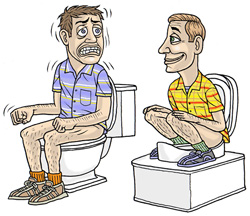 Shortly before Christmas in 1978, the leader of the free world came down with a severe case of hemor! rhoids. The pain was so bad that President Carter had to take a day of f from work. A few weeks later, Time Magazine asked a proctologist named Michael Freilich to explain the president's ailment. "We were not meant to sit on toilets," he said, "we were meant to squat in the field." He's probably right.
Michael Freilich isn't the first doctor to suggest that sitting on toilets—a recent phenomenon, stemming from the invention of the flush toilet in 1591—might be unhealthy. By the 1960s and '70s, the idea was relatively commonplace. Architect Alexander Kira argued in his 1966 book The Bathroom that human physiology is better suited to the squat. According to Bockus's Gastroenterology, a standard medical text from 1964, "the ideal posture for defecation is the squatting position, with the thighs fixed upon the abdomen."
Modern-day squat evangelists make money off the claim that a "more natural" posture wards off all sorts of health problems, from Crohn's disease to colon cancer. Inventor Jonathan Isbit runs a modest online business selling Nature's Platform—a homemade, $150 device that fits over toilets to make them more lik! e holes in the ground.* (He also posted the Bockus quote above to the Wikipedia entry on defecation.) Other entrepreneurs peddle similar products, like the In-Lieu, the Lillipad, the Evaco toilet converter, and, for those who don't like explaining their squat platform to house guests, a $688 Singaporean toilet that lets users switch among different squatting and sitting postures, from the "East Asian squat" to the "aft sit."* (Confused? Watch the video.)
That may sound like a bunch of Internet quackery, but there's now some e! mpirical evidence for the claim that defecation posture affects your body. The more extreme assertions about squatting—that it prevents cancer, for example—remain untested. But when it comes to hemorrhoids—a painful swelling of the veins in the anal canal that affects half of all Americans—new research suggests that you may want to get your butt off the toilet.
Before we dive into the data, let's review the mechanics of going to the bathroom. People can control their defecation, to some extent, by contracting or releasing the anal sphincter. But that muscle can't maintain continence on its own. The body also relies on a bend between the rectum—where feces builds up—and the anus—where feces comes out. When we're standing up, the extent of this bend, called the anorectal angle, is about 90 degrees, which puts upward pressure on the rectum and keeps feces inside. In a squatti! ng posture, the bend straightens out, like a kink ringed out of a gard en hose, and defecation becomes easier.
Proponents of squatting argue that conventional toilets produce an anorectal angle that's ill-suited for defecation. By squatting, they say, we can achieve "complete evacuation" of the colon, ridding our bowels of disease-causing toxins. But there's no reason to think that getting into a squat will make defecation more complete, nor that most people are sickened by their colons. If squatting does provide a health benefit, just as Michael Freilich stated in Time, it comes in the form of hemorrhoid prevention.
Hemorrhoids may be brought on by pregnancy, obesity, and receiving anal sex. But the main cause is straining during bowel movement. Straining increases the pressure in your abdomen, causing the veins that line your anus to swell. In hemorrhoi! d patients, those veins stay swollen and sometimes bleed. In theory, squatting might stave off hemorrhoids by making defecation easier, reducing the need to strain and decreasing abdominal pressure.
An Israeli doctor named Dov Sikirov tested this idea for a 2003 study published in Digestive Diseases and Sciences. He had several dozen patients defecate in each of three positions: sitting on a 16-inch-high toilet, sitting on a 12-inch-high toilet, and squatting over a plastic container. He asked his subjects to record how long each bowel movement took and rate the effort required on a four-point scale ranging from effortless to difficult. Sikirov found that, when squatting, subjects averaged a mere 51 seconds to move their bowels, versus 130 seconds when sitting on a high toilet. And as they moved from a sit to a squat, subjects were more likely to rate the experience as easier! .
Then last year, a group of Japanese doctors extended Sikirov' s findings by looking at what happens inside the body while people squat and sit. For a study published in the medical journal Lower Urinary Tract Symptoms, six subjects had their rectums filled with a contrast solution and then released the fluid from a squatting or a sitting position while being filmed with X-ray video. Image analysis showed that the anorectal angle increased from 100 degrees to 126 degrees as the subjects moved from a sit to a squat. The researchers also recorded abdominal pressure, and found that the subjects were straining less when they squatted.
Of course, it's one thing to show that squatting streamlines defecation and reduces hemorrhoid risk. It's another to actually move your bowels while you squat. But how hard could it be? For most of human history—several hundred thousand years—we've squatted. Today, 1.2 billion people s! quat because they simply don't have a toilet, while many, many more in Asia, the Middle East, and parts of Europe use toilets designed specifically for squatting. And for 28 years—from his junior year at Yale in 1970 to the moment when he completed the first Nature's Platform prototype in 1998—Jonathan Isbit "perched," as he put it, squatting on the rim of toilet seats. So I decided to try it—each morning for a week, following a bowl of corn flakes and a cup of coffee.
Besides tipping over, there's little danger in squatting over a modern sit toilet. Both American Standard and Kohler say that floor-mounted toilets are designed to hold at least 1,000 pounds. (Still, neither company recommends perching.) The American Society for Engineers requires that wall-mounted toilets hold 500 pounds. But squatting on your toile t seat is not for everybody. Even when I was holding onto a towel rack, the situation felt precarious. A bedpan or a plastic container would have been easier, but I didn't have the former and the latter seemed gross. So I forged ahead, pushing through the week—or, as it turned out, not pushing: Bowel movements just seem to happen in a squat. My 10-minute routine dropped to a minute, two at the most, and within a few days my knees stopped complaining.
Although the week is now over, I'll probably squat again. At the very least, I gained an hour over seven days. It seems doubtful, though, that squatting, even if it helps hemorrhoids, will become the next back-to-nature craze—the new barefoot running shoe or caveman diet. Sit toilets, in the short term at lea! st, are more comfortable than the squat toilets you might find in Europe. In fact, since Jimmy Carter's bout of hemorrhoids sit toilets have actually grown in height, pushing the anorectal angle in the wrong direction. Standard models, 14 inches from floor to rim, now compete with "comfort height" toilets that tower more than 17 inches of the floor. Americans, now fatter than ever, are having trouble standing up from a sit, never mind a squat.
Like Slate on Facebook. Follow us on Twitter.
Correction, Aug. 27, 2010: This article originally misspelled the first name of Jonathan Isbit. (Return to the corrected senten! ce.)
Correction, Sept . 13, 2010: The original sentence described the $688 toilet as being Japanese. (Return to the corrected sentence.)
Daniel Lametti is a scientist and writer who lives in Brooklyn.
Article URL: http://www.slate.com/id/
© 2010 Washingtonpost.Newsweek Interactive Co. LLC
Wednesday, April 13, 2011
Is Sugar Toxic?
Is Sugar Toxic?
http://www.nytimes.com/2011/04/17/magazine/mag-17Sugar-t.html?_r=1&=&pagewanted=all

Sugar: The Bitter Truth<---You Tube video
Please watch this and learn something instead of watching trash tv!
http://www.nytimes.com/2011/04/17/magazine/mag-17Sugar-t.html?_r=1&=&pagewanted=all

Sugar: The Bitter Truth<---You Tube video
Please watch this and learn something instead of watching trash tv!
Tuesday, March 29, 2011
Gorillas Going Green
Researchers at Case Western Reserve University and the Cleveland Metroparks Zoo are adjusting gorilla diets in an effort to understand and treat cardiac issues in the animals.
Look what happens when the gorillas are allowed to eat their natural diet! Now if we just can end this low-fat, high carbohydrate experiment in which we are the guinea pigs and get on with a proper omnivorous diet we should end up a lot better for it!
http://hunter-gatherer.com/blog/health-problems-disappear-when-captive-gorillas-fed-wild-diet
Friday, March 25, 2011

Thursday, March 10, 2011

Wednesday, March 2, 2011
Reverse Magazine: Woman Are Wrong About Fat Loss and Fitness
Reverse Magazine: Woman Are Wrong About Fat Loss and Fitness: " The Dirty Dozen Mistakes Women Make The female population has tremendous leverage in the marketplace. Anyone in advertisin..."
Army's new fitness tests add taste of battlefield
http://news.yahoo.com/s/ap/us_army_new_fitness_test
FORT JACKSON, S.C. – Sit-ups don't make a soldier, the Army has decided. So its 30-year-old fitness requirements are getting a battlefield-inspired makeover.
Soon every soldier will have to run on a balance beam with two 30-pound canisters of ammunition, drag a sled weighted with 180 pounds of sandbags and vault over obstacles while carrying a rifle. Those were just some of the tests the Army unveiled Tuesday as it moves toward making its physical training look more like combat.
Right now soldiers have to complete sit-ups, push-ups and a two-mile run twice a year within times that vary by age and gender. Lt. Gen. Mark Hertling, the general in charge of the Army's initial military training, said he has been working to change that test for years.
Hertling said the current test "does not adequately measure components of strength, endurance, or mobility," or predict how well a soldier would do under fire.
A new annual "combat readiness" test includes running 400 meters — about a quarter of a mile — with a rifle, moving through an obstacle course in full combat gear, and crawling and vaulting over obstacles while aiming a rifle. Soldiers also will have to run on a balance beam while carrying 30-pound ammo boxes and do an agility sprint around a course field of cones.
Soldiers also will have to drag sleds weighted with sandbags to test their ability to pull a fallen comrade from the battlefield. The combat test might be given before deployments as well as annually, but that has not been decided.
The Army will keep elements of its old assessment in a "physical readiness" test, which adds such things as a 60-yard shuttle run and a standing long jump to one minute of push-ups and a 1.5-mile timed run. This might be given every six months, said Frank Palkoska, head of the Army's Fitness School at Fort Jackson.
Hertling said trials of the new program are starting this month at eight bases and the plan could be adopted Army-wide after reviews later this year.
Soldiers who ran the proposed "combat readiness" portion of the test Tuesday told reporters the exercises were tough, even for combat veterans.
Wearing a battle helmet and carrying a rifle, Staff Sgt. Timothy Shoenfelt teetered as he trod the balance beam, holding ammo tins in each hand. His pace slowed a bit as he dragged the green sled behind him, then held his M-4 steady as he strode sideways through the "point-move-aim" portion of the test.
"My quads are on fire!" the 31-year-old from Indiana, Pa., said afterward. "It really made me breathe hard and challenged a lot of muscle groups."
Wheeled vehicle mechanic and Sgt. 1st Class Cornelius Trammell, 33, of Eufaula, Ala., said it will be important for all soldiers to go through tests, even if their jobs are behind desks. He laughed when reporters commented on his sweaty face.
"You never know when you might need it, whether you are in the infantry or if you're a mechanic," said Trammell, who's been deployed three times.
The tests will be given to all soldiers and officers, including Army Reserves and National Guard, even those recalled soldiers who are now over 60, officials said. Specific gender and age standards are still being worked out, Palkoska said.
The shift follows other Army efforts to overhaul training, improve diets and help older soldiers keep fit. Hertling said the Army is trying to better prepare soldiers for the 40 to 70 pounds of weapons and body armor many of them need to carry in Afghanistan and Iraq.
"Soldiers like to be challenged. This will definitely challenge them," Hertling said.
The Army also is hoping to reduce injuries — both in the field and from repetitive exercises.
"This is about training smarter, not just training more," Hertling said.
Staff Sgt. Danica Foster, 28, of Brooklyn, N.Y., who pumped through a shuttle run and did push-ups for the "physical readiness" section, said the new tests will require soldiers to work on their upper body strength.
Female soldiers will have to work to get them done, she said.
"I honestly believe, though, that if I can do this, anybody can," she said with a laugh.
Besides Fort Jackson, the program will be tested at Fort Leonard Wood, Mo.; Fort Benning, Ga.; Fort Sill, Okla.; Fort Bliss, Texas; Fort Bragg, N.C.; Fort Lewis, Wash.; and at the Army's military academy at West Point.
FORT JACKSON, S.C. – Sit-ups don't make a soldier, the Army has decided. So its 30-year-old fitness requirements are getting a battlefield-inspired makeover.
Soon every soldier will have to run on a balance beam with two 30-pound canisters of ammunition, drag a sled weighted with 180 pounds of sandbags and vault over obstacles while carrying a rifle. Those were just some of the tests the Army unveiled Tuesday as it moves toward making its physical training look more like combat.
Right now soldiers have to complete sit-ups, push-ups and a two-mile run twice a year within times that vary by age and gender. Lt. Gen. Mark Hertling, the general in charge of the Army's initial military training, said he has been working to change that test for years.
Hertling said the current test "does not adequately measure components of strength, endurance, or mobility," or predict how well a soldier would do under fire.
A new annual "combat readiness" test includes running 400 meters — about a quarter of a mile — with a rifle, moving through an obstacle course in full combat gear, and crawling and vaulting over obstacles while aiming a rifle. Soldiers also will have to run on a balance beam while carrying 30-pound ammo boxes and do an agility sprint around a course field of cones.
Soldiers also will have to drag sleds weighted with sandbags to test their ability to pull a fallen comrade from the battlefield. The combat test might be given before deployments as well as annually, but that has not been decided.
The Army will keep elements of its old assessment in a "physical readiness" test, which adds such things as a 60-yard shuttle run and a standing long jump to one minute of push-ups and a 1.5-mile timed run. This might be given every six months, said Frank Palkoska, head of the Army's Fitness School at Fort Jackson.
Hertling said trials of the new program are starting this month at eight bases and the plan could be adopted Army-wide after reviews later this year.
Soldiers who ran the proposed "combat readiness" portion of the test Tuesday told reporters the exercises were tough, even for combat veterans.
Wearing a battle helmet and carrying a rifle, Staff Sgt. Timothy Shoenfelt teetered as he trod the balance beam, holding ammo tins in each hand. His pace slowed a bit as he dragged the green sled behind him, then held his M-4 steady as he strode sideways through the "point-move-aim" portion of the test.
"My quads are on fire!" the 31-year-old from Indiana, Pa., said afterward. "It really made me breathe hard and challenged a lot of muscle groups."
Wheeled vehicle mechanic and Sgt. 1st Class Cornelius Trammell, 33, of Eufaula, Ala., said it will be important for all soldiers to go through tests, even if their jobs are behind desks. He laughed when reporters commented on his sweaty face.
"You never know when you might need it, whether you are in the infantry or if you're a mechanic," said Trammell, who's been deployed three times.
The tests will be given to all soldiers and officers, including Army Reserves and National Guard, even those recalled soldiers who are now over 60, officials said. Specific gender and age standards are still being worked out, Palkoska said.
The shift follows other Army efforts to overhaul training, improve diets and help older soldiers keep fit. Hertling said the Army is trying to better prepare soldiers for the 40 to 70 pounds of weapons and body armor many of them need to carry in Afghanistan and Iraq.
"Soldiers like to be challenged. This will definitely challenge them," Hertling said.
The Army also is hoping to reduce injuries — both in the field and from repetitive exercises.
"This is about training smarter, not just training more," Hertling said.
Staff Sgt. Danica Foster, 28, of Brooklyn, N.Y., who pumped through a shuttle run and did push-ups for the "physical readiness" section, said the new tests will require soldiers to work on their upper body strength.
Female soldiers will have to work to get them done, she said.
"I honestly believe, though, that if I can do this, anybody can," she said with a laugh.
Besides Fort Jackson, the program will be tested at Fort Leonard Wood, Mo.; Fort Benning, Ga.; Fort Sill, Okla.; Fort Bliss, Texas; Fort Bragg, N.C.; Fort Lewis, Wash.; and at the Army's military academy at West Point.
Sunday, December 5, 2010
Subscribe to:
Posts (Atom)